
Scene Understanding /
Multiple cameras, one shared understanding
How a shared scene model reconciles viewpoints, distinguishes corrections from real changes, and keeps answers connected to evidence.
At 18:00, Camera A looks down a station passage toward a temporary barrier. From that angle, the barrier appears to span the route. Camera B looks across the same entrance and sees a gap beside it, with a passenger walking through.
An initial interpretation—“the passage is fully blocked”—needs correcting. The barrier has not moved. The second camera has supplied evidence that the first view could not resolve.
A barrier is visible; its full extent is not
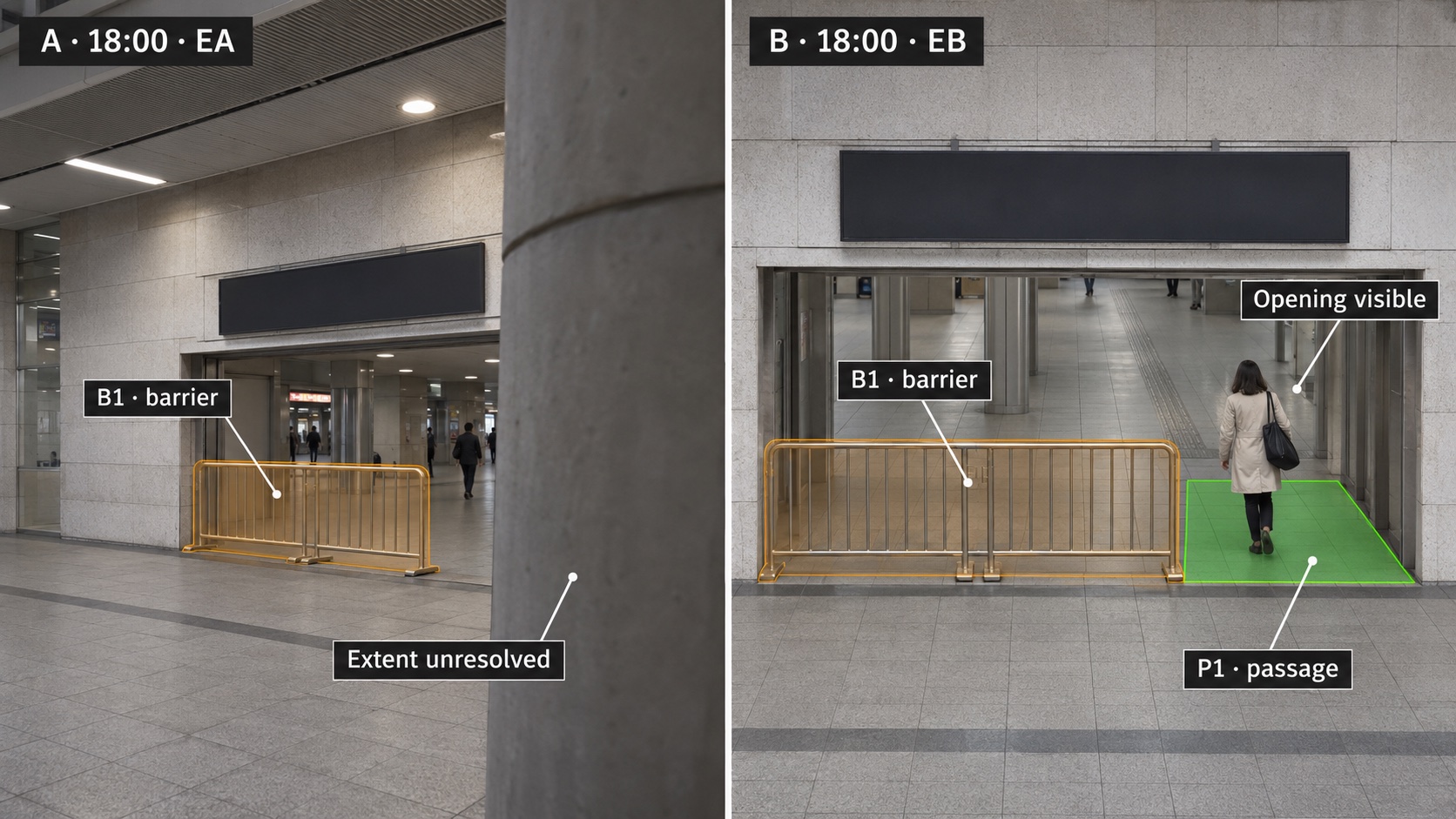
This is a practical extension of the visual context engine: multiple cameras contribute observations to a shared model of the place. The result should preserve what each camera actually supports, where coverage ends, and how an interpretation changes when better evidence arrives.
Start with the place, then associate the views
The common reference is Passage P1, its entrance, and the surrounding station geometry. Camera-local labels such as “region 7” or “track 42” acquire meaning through their association with those site entities. A shared scene graph connects the entities, spatial relationships, time-scoped states, and supporting observations.
That association requires work. Camera positions, calibration, stable landmarks, and a site map can relate image regions to physical space. Moving cameras require updated poses or registration. Clock offsets and their uncertainty must also be recorded: frames received together may have been captured at different times.
Research such as ConceptGraphs demonstrates multi-view association as a building block for constructing structured scene representations from posed RGB-D observations. Its robotics results provide a useful precedent, while ordinary station CCTV has different sensing and calibration conditions. Gu et al., ConceptGraphs, ICRA 2024.
A camera network does not need to identify every passenger across every view to answer whether a barrier spans an entrance. It does need to establish that the views concern the same entrance. For a journey or crossing count, person or event association becomes necessary. Two observations of one crossing must not become two crossings; an uncertain match should remain uncertain.
The ontology supplies stable concepts such as passage, barrier, opening, and crossing. The site model supplies P1 and its geometry. The observations supply what was visible at a particular time. Adding a camera ordinarily adds evidence and coverage, rather than changing those definitions.
Belief revision: correct the interpretation
A belief here is a recorded assertion with evidence and a status. It can be accepted, provisional, disputed, or superseded. It is useful precisely because it can be challenged.
In the station example, A supports “B1 is present at the entrance.” Its perspective does not support “B1 spans the entire entrance.” If the system nevertheless recorded a full blockage, the simultaneous view from B provides grounds to revise that assertion. The corrected account is narrower: a barrier occupies part of the entrance, and a passenger is observed using the adjacent opening.
This is belief revision: changing an interpretation of the same situation when new information challenges it. If B’s footage arrives at 18:03 but was captured at 18:00, it can revise the account of 18:00. It does not establish that the opening appeared at 18:03.
Keep the original assertion, its evidence, the reason for correction, and the replacement. Any answer derived from the full-blockage assertion should be flagged for review or recalculation. The revised state does not establish that the passage meets a required width, is accessible to every user, or is authorized for use; those are separate questions.
Belief update: record a change in the place
At 18:20, staff move another barrier across the remaining gap. Suppose usable video records that action and the resulting arrangement. The entrance’s physical configuration has now changed. The engine should retain the earlier opening and add a later state in which barriers span the entrance.
The opening is visible, then covered by a barrier
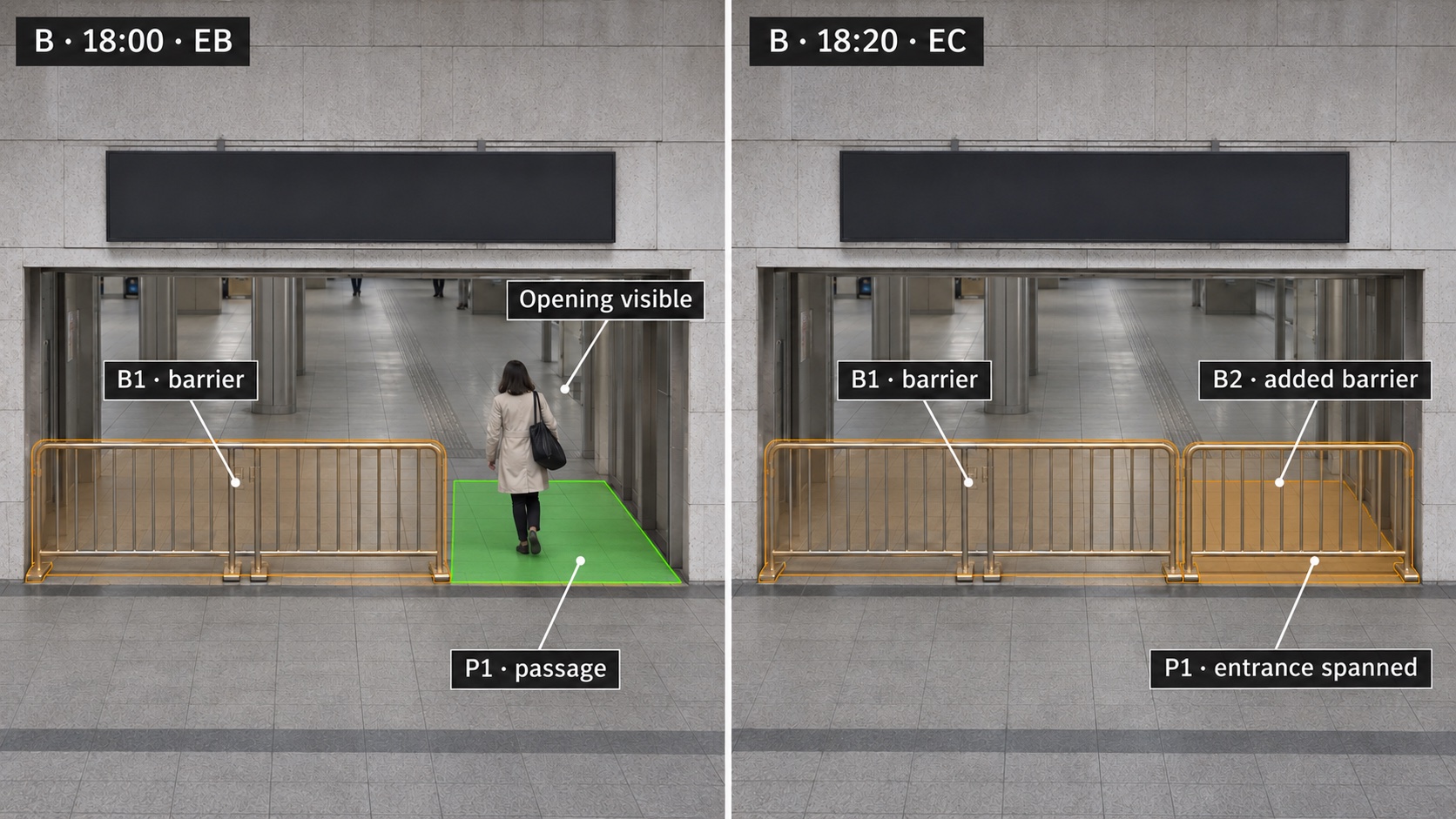
This is belief update: maintaining an account as the world changes. The distinction between revision and update comes from knowledge representation research. We use it here to guide record handling; an implementation would still need to specify its own acceptance and conflict-resolution procedures. Katsuno and Mendelzon, On the difference between updating a knowledge base and revising it.
- Revision: our account changes
- B’s 18:00 view corrects an overinterpretation of A’s 18:00 view. The opening was already there; the earlier full-blockage claim is superseded.
- Update: the situation changes
- Later footage records a barrier being placed across the gap. The previously observed configuration remains valid for its earlier time; a new configuration follows it.
Some investigations require both. A delayed recording may reveal that staff closed the opening earlier than first reported. That recording documents a physical update, while its arrival prompts revision of the stored transition time.
When cameras disagree, compare the claims
“Clear” and “blocked” are too vague to reconcile. Before choosing between them, resolve the subject, property, spatial extent, and capture interval. One view may describe a clear approach to the entrance while another describes an obstruction beyond it. Both observations can be correct.
- Different capture times
- A shows an opening at 18:00; B shows a barrier at 18:20. Check the intervening footage before treating the observations as contradictory.
- Different coverage
- A sees the approach but cannot see the far side of B1. “No opening detected” does not establish that no opening exists.
- Different definitions
- One procedure reports any obstruction; another reports a full-width obstruction. Compare the same predicate under the same geometry and rule version.
- A genuine unresolved conflict
- Aligned views make incompatible claims about the same entrance and time. Retain both observations, mark the assertion disputed, and request targeted inspection.
Resolution should depend on the evidence relevant to the claim: visibility, image quality, calibration, track continuity, and the procedure’s tested performance. A sharp side view can be more informative about a gap than several frontal views. Majority voting would conceal that difference.
Nor should confidence increase automatically with camera count. Views may share the same blind spot, model error, or source recording. Scores from different models are not interchangeable probabilities unless calibrated for the task. Where dependence is unknown, preserve the sources and qualify the conclusion instead of multiplying confidence scores.
Keep two timelines
The engine needs capture time, describing when the scene was observed, and record time, describing when an observation or decision entered the system. This allows two different questions: “What happened at 18:00?” and “What did the system believe at 18:01?”
W3C/OGC SOSA provides a useful observation pattern, including the observed subject and property, result, procedure, phenomenon time, and result time. An operational service also needs its own ingestion and revision history. W3C/OGC, Semantic Sensor Network Ontology, 2017 edition.
Coverage must have a time boundary too. If Camera B goes offline after observing the opening, the last observation becomes stale. A’s continuing inability to see the gap cannot keep B’s earlier conclusion current indefinitely. Missing coverage should appear in the answer.
Give an answer a return path to evidence
A supervisor asks: “Was Passage P1 fully blocked at 18:00, and what changed later?” A bounded answer could read:
Example answer. At 18:00, the available evidence does not support a full-width barrier blockage. Camera A shows Barrier B1 but cannot resolve its full extent; Camera B shows an adjacent opening and a passenger crossing it. The initial full-blockage interpretation was corrected using B’s footage of the same time. Later video records an additional barrier spanning that opening at 18:20. This establishes a change in the barrier arrangement; it does not by itself establish an approved closure or its effect on passenger travel.
Every material statement needs its own source reference. A proposed evidence manifest for this fictional example would contain:
- EA · A sees the barrier
- Recording A-1800, starting at 18:00; offsets 0–10 seconds. Retain the region for B1 and the unresolved entrance extent. Supports barrier presence, not full blockage.
- EB · B reveals the opening
- Recording B-1800, starting at 18:00; offsets 0–10 seconds. Retain the opening region and crossing track. Supports the revision of the same-time interpretation.
- EC · the arrangement changes
- Recording B-1800; offsets 1190–1210 seconds, corresponding to 18:19:50–18:20:10. Retain the placement action and surrounding context.
- Decision and dependencies
- Link the superseded assertion to its replacement, supporting observations, reviewer or processing run, clock correction, geometry version, and rule version.
These identifiers describe how real media would be addressed; the illustrations above are not playable recordings. A deployed agent should return authorized links to the actual segments and preserve the distinction between a source observation, a derived relationship, and a final answer. Claiming uninterrupted blockage over an interval would require coverage for that interval, beyond these short clips.
W3C PROV-O supplies a standard vocabulary for derivation and responsibility. It can help express that an answer used a scene assertion, that the assertion was derived from particular observations, and that a later decision superseded an earlier result. The media, transformations, access controls, and retention policy still need implementation. W3C, PROV-O.
What this means for Parallel Sight
A shared model gives AI agents precise questions to ask: Which view supports this relationship? Are the observations simultaneous? Has the geometry changed? Which conclusions depend on the disputed record? What evidence would resolve the uncertainty?
Situation-specific perception can maintain recurring tracks and spatial observations. A VLM can interpret an unfamiliar arrangement or help select a view for inspection. Geometry and temporal services establish measurable relationships. The shared scene layer maintains identity, history, and provenance across those contributions.
The first evaluation should test whether adding a second view corrects blind spots without introducing false associations or double counting. Include clock drift, moved cameras, contradictory detections, delayed recordings, and outages. Measure correction accuracy, transition timing, unresolved conflicts, and whether evidence links support the claims attached to them. Compare the shared model against independent per-camera answers on held-out footage.
More cameras expand the available evidence. A dependable understanding of the place comes from associating that evidence carefully, retaining its limits, and allowing conclusions to change for an explicit reason.